Unit 6 was all about the skeletal system. First, we learned about the different types of bones, what bones are made of, and how they repair themselves. The axial bones are the bones that make up our foundation and protect our organs. The appendicular bones help us with movement. Bones are classified by their shape: long, short, flat, and irregular. The two types of bone tissue of bone are compact and spongy. The cells that are responsible for bone remodeling are osteocytes, osteoblasts, and osteoclasts. Osteoblasts are bone forming cells and osteoclasts are bone destroying cells. Next, we learned about the disorders of the skeletal system like arthritis. Osteoporosis and rickets are caused by a deficiency in vitamins and minerals. We also learned about kyphosis, lordosis, and scoliosis which are all diseases relating to an abnormal curvature of the spine. Lastly, we learned the names of all the bones and the different kinds of joints.
I want to learn more about the cures for bone diseases, if any. Do you have to live with the disease forever or are some of the diseases reversible? For example, osteoporosis is by loss of minerals in the bones, making them more brittle. Does this mean a person with osteoporosis just needs to have more minerals in their diet or is there something more? I would also like to learn more about the similarities and differences between human bones and other animal bones because of the owl pellet lab. So far this semester has been going well and I've been keeping up with my New Years goals.
Saturday, February 27, 2016

Thursday, February 25, 2016
Owl Pellet Lab
 In this lab, my partner and I dissected an owl pellet. First, we divided the pellet in half and worked on our halves separately. Using forceps and a probe, we picked apart the owl pellet. We found leg bones and some ribs but unfortunately, there was no skull in the pellet. We put together the bones that we found and came to the conclusion that the animal was a shrew. We knew that the animal had to be a rodent of some kind because we found lots of hair in the pellet, meaning the animal couldn't have been a bird. Next, we looked at the differences in bone structure in shrews, moles, and voles. We found two pieces of a pelvis that looked like that of a shrew because of the loops at the ends of the bones. The shape of the femur of the shrew also matched the femur that we found in the pellet. We also found a lower back leg that could have been that of a vole or a shrew; however, we narrowed it down to a shrew's back leg because of the shapes at the ends of the tibia and fibula, as well as the space between the two bones. So by looking at the pelvis, the upper back leg bones, and the lower back leg bones we found, we concluded that the animal was indeed a shrew.
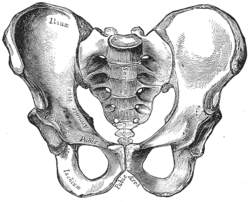 |
| human pelvis |
 |
| human tibia & fibula |

Thursday, January 28, 2016
Unit 5 Reflection
Unit 5 was about the digestive system, endocrine system, and lymphatic system. We learned about the organs involved in the systems and all their functions. To further understand the digestive system we measured our alimentary canal and made it with string and ribbon. We learned about fuel metabolism and the fed, fasting, and starvation states. We went over how our organs work in different conditions, for example how the brain uses glucose for fuel and the muscles can use glucose, fatty acids, and ketone bodies for fuel. We learned a lot about insulin and glucagon, two hormones that regulate blood glucose levels. A big part of this unit was about diabetes, which I didn't know much about at first. Now I have a greater understanding of the way insulin works in our bodies and how diabetes can be caused by so many different factors such as genetics, stress, and physical inactivity.
I enjoyed learning about the body systems because they were pretty straightforward. I struggled a little with understanding fuel metabolism because there were so many steps and hormones that played a part in the whole process. I wanted to learn more about metabolism and lactose intolerance and I got the chance to when we had researched and discussed articles in class. So far I have been keeping up with my New Year's goals. I still need to work on getting 7-8 hours of sleep everyday but I have cut down on my screen time.


Wednesday, January 6, 2016
Digestive System Lab
1. In this lab, I measured my digestive system out with ribbon and string. I learned that my digestive system stretched almost all the way across the classroom. I liked this lab because it really put into perspective how long our digestive system is and made me think about how the alimentary canal can fit into the human body.

2. The length of my digestive system is almost 5x longer than my height. My digestive system fits inside my abdomen because the small and large intestines are folded into a small
3. I think it takes a few hours for food to move through the entire digestive system. According to Mayo Clinic, however, food can take 24 to 72 hours to digest. This time varies based on age, amount of physical activity, and the type of food being eaten. For example, the body digests fiber very quickly compared to fruits and vegetables.
4. Digestion is breaking down food into smaller pieces. It begins in the stomach and occurs in the small intestine. Absorption is taking in nutrients and water, which occurs in the small and large intestine.
5. I want to learn more about the enzymes that break down the food and about the structures of the organs of the digestive system.
2. The length of my digestive system is almost 5x longer than my height. My digestive system fits inside my abdomen because the small and large intestines are folded into a small
3. I think it takes a few hours for food to move through the entire digestive system. According to Mayo Clinic, however, food can take 24 to 72 hours to digest. This time varies based on age, amount of physical activity, and the type of food being eaten. For example, the body digests fiber very quickly compared to fruits and vegetables.
4. Digestion is breaking down food into smaller pieces. It begins in the stomach and occurs in the small intestine. Absorption is taking in nutrients and water, which occurs in the small and large intestine.
5. I want to learn more about the enzymes that break down the food and about the structures of the organs of the digestive system.
Tuesday, January 5, 2016
New Year Goals
For 2016, one of my SMART goals is to cut down the time I spend watching TV or using social media. Spending time on my phone leads to procrastination and staring at a screen for hours isn't healthy. I will put my phone away while doing homework to steer clear of its distractions. Not getting work done efficiently has made me lose sleep as well. I'm constantly tired and can't focus during school. This is why my second SMART goal is to get more sleep. I will make sure to get at least 7-8 hours of sleep per night by making sure I finish my homework before 11 pm. Hopefully this will improve my grades as well. Both of these relate back to anatomy and physiology, especially getting some sleep.
Sunday, November 15, 2015
Thursday, November 12, 2015
Heart Dissection Lab
1. The purpose of the pericardium is to protect the heart.
2. Arteries take blood away from the heart and veins bring blood to the heart. Valves have thinner walls and have one-way valves to prevent backflow.
3. The auricle inflates when blood pumps into the heart and increases the volume of the atrium.
4. There is more fat at the top of the heart near the atrium. The ventricles have thicker walls than the atria walls.
6.
 7. The chordate tendinae and the papillary muscles are important to heart function because they
8.

9. The semi-lunar valves prevent blood from the atrium from entering the heart again.
10. Valve disease on the right side of the heart results in swelling in the feet and ankles because the blood returns to that area of the body. Since the tricuspid valves stops working, blood would go back through the inferior vena cava and back to the lower part of the body.
b) If valve disease occured on the left side of the heart, it would mess up the blood flow between the lungs and the left atrium. This would interrupt the flow of oxygenated blood to the rest of the heart.
11.

12. The left side of the heart deals with oxygenated blood and the right side deals with deoxygenated blood.
2. Arteries take blood away from the heart and veins bring blood to the heart. Valves have thinner walls and have one-way valves to prevent backflow.
3. The auricle inflates when blood pumps into the heart and increases the volume of the atrium.
4. There is more fat at the top of the heart near the atrium. The ventricles have thicker walls than the atria walls.
6.

8.

9. The semi-lunar valves prevent blood from the atrium from entering the heart again.
10. Valve disease on the right side of the heart results in swelling in the feet and ankles because the blood returns to that area of the body. Since the tricuspid valves stops working, blood would go back through the inferior vena cava and back to the lower part of the body.
b) If valve disease occured on the left side of the heart, it would mess up the blood flow between the lungs and the left atrium. This would interrupt the flow of oxygenated blood to the rest of the heart.
11.

12. The left side of the heart deals with oxygenated blood and the right side deals with deoxygenated blood.
13.

Subscribe to:
Posts (Atom)